

SSADM Diagram Software - Structured Systems Analysis and Design Methodology

Introduction - Structured Systems Analysis and Design Methodology (SSADM)
SSADM (Structured Systems Analysis And Design Method) is another method dealing with information systems design. It was developed in the UK by CCT (Central Computer and Telecommunications Agency) in the early 1980s. It is the UK government's standard method for carrying out the system analysis and design stages of an information technology project.
SSADM has been traditionally used for the development of medium or large systems. However, one variant of SSADM is "Micro SSADM" which is for small systems. SSADM starts from defining the information system strategy and then develops a feasibility study module. These are followed by requirements analysis, requirements specification, logical system specification and a final physical system design.
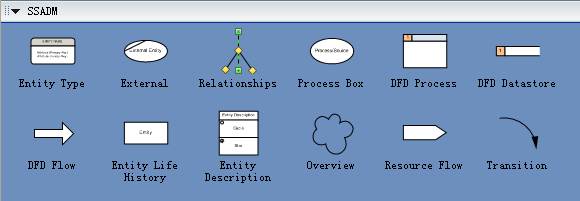
Edraw contains special shapes and settings for creating SSADM Diagrams. Use case diagrams illustrate how the outside world interacts with elements of the application system.
Free Download SSADM Software and View All Examples
In Edraw Professional, the SSADM template and shapes are in the Software folder.
System Requirements
Works on Windows 7, 8, 10, XP, Vista and Citrix
Works on 32 and 64 bit Windows
Works on Mac OS X 10.2 or later
Features List of SSADM Diagram Software
- Drag-and-drop interface
- Point-and-click Editor
- Built-in Symbols
- Ready-made Templates
- Dynamic Help & Interface Labels
- Embedded Config/Design Data
- Created Automatically
- Auto-Updating
- Easy to Use
SSADM Symbols
Examples of SSADM Diagram
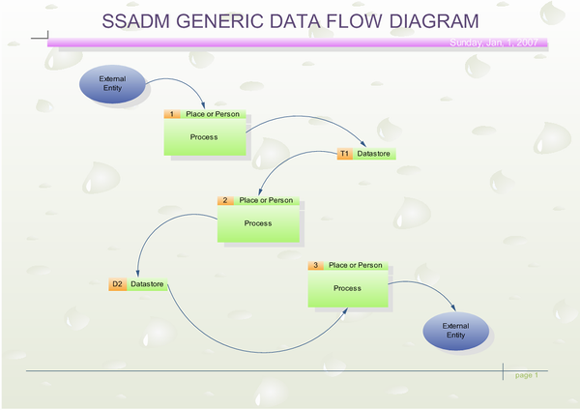
Free Download SSADM Diagram Software and View All Examples
SSADM consists of 5 main stages (which are broken-down in several sub-stages).
The 5 main stages are:
Feasibility Study: The Feasibility Study involves a high level analysis
of a business area to determine whether it's feasible development for a particular
system. Data Flow Modeling and (high-level) Logical Data Modeling can be used as
technique during this stage.
Requirements Analysis: In the Requirements Analysis stage, requirements
are identified and the current business environment is modeled, business system
options are produced and presented. One of these options will be chosen then
refined. Data Flow Modeling and Logical Data Modeling can be used as technique
during this stage.
Requirements Specification: In the Requirements Specification, the
functional and non-functional requirements are specified as a result of the
previous stage. Data Flow Modeling, Logical Data Modeling and Entity Event
Modeling can be used as technique during this stage.
Logical System Specification: In the Logical System Specification, the
development and implementation environment are specified, and the logical design
of update and enquiry processing and system dialogues are carried out.
Physical Design: During the Physical Design stage, the logical system
specification and technical specification are used to create a physical design
and a set of program specifications.
Who Can Use Them and How
- Software developers: Represent software applications using the Unified Modeling Language (UML) notation.
- Software developers: Illustrate and interpret software application relationships, actions, and connections.
- Program managers: Show high-level static software structures in presentations and specification documentation.
Unlike rapid application development which conducts steps in parallel, SSADM builds each step on the work that was prescribed in the previous step with no deviation from the model. Because of the rigid structure of the methodology, SSADM is praised for its control over projects and its ability to develop better quality systems.