Mesh Network Topology and Architecture

Mesh Network Topology
Mesh network topology is one of the key network architectures in which devices are connected with many redundant interconnections between network nodes such as routers and switches. In a mesh topology, if any cable or node fails, there are many other ways for two nodes to communicate. While ease of troubleshooting and increased reliability are definite pluses, mesh networks are expensive to install because they use a lot of cabling. Often, a mesh topology will be used in conjunction with other topologies (such as Star, Ring and Bus) to form a hybrid topology. Some WAN architecture, such as the Internet, employ mesh routing. Therefore, the Internet allows sites to communicate even during a war.
There are two types of mesh topologies: full mesh and partial mesh:
- Full mesh topology occurs when every node has a circuit connecting it to every other node in a network. Full mesh is very expensive to implement and yields the greatest amount of redundancy, so in the event that one of those nodes fails, network traffic can be directed to any of the other nodes. Full mesh is usually reserved for backbone networks.
- With partial mesh, some nodes are organized in a full mesh scheme but others are only connected to one or two in the network. Partial mesh topology is commonly found in peripheral networks connected to a full meshed backbone. It is less expensive to implement and yields less redundancy than full mesh topology.
Mesh Network Diagram Software
Edraw Network Diagram is ideal for network engineers and network designers who need to draw mesh network topology and architecture diagrams. It has defined some commonly used WAN symbols in drawing WAN diagrams. Just drag and drop pre-drawn shapes representing computers and network devices. Double click and set equipment data.
Free Download Mesh Network Diagram Software and View All Examples
Examples of Local Area Network Technologies
|
Examples of Wide Area Network Technologies Created by Edraw! |
|
|
|
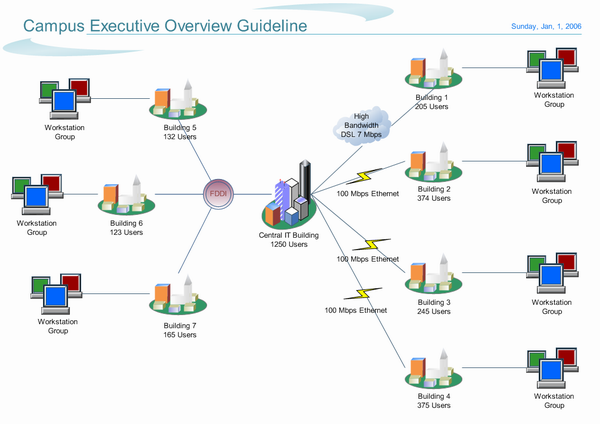
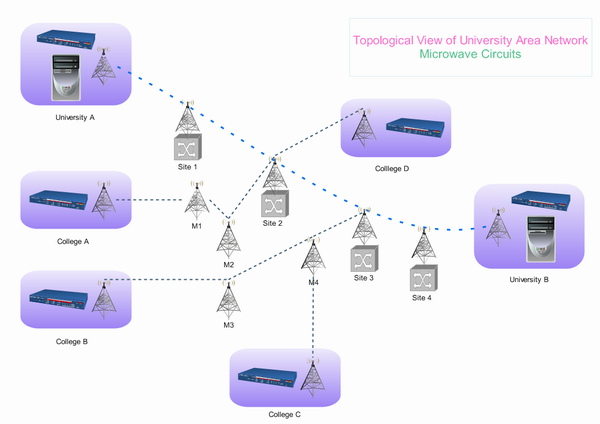
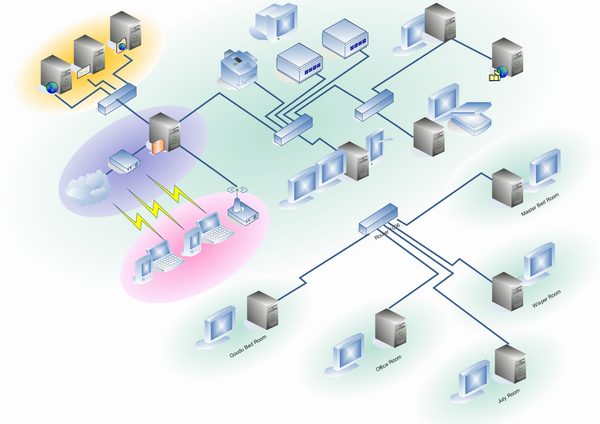
| Campus Network Diagram | Microwave Topology | Network Planform |
|
|
|
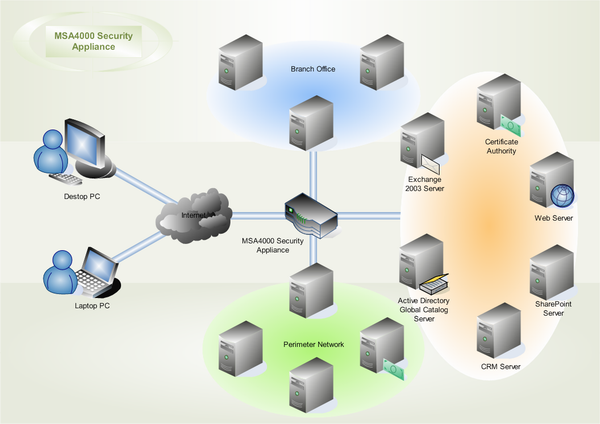
| Security Network | Outlook Web Access | WAN Diagram |
Free Download Network Diagram Software and View All Examples
Mesh Topology Mesh topologies involve the concept of routes. Unlike each of the previous topologies, messages sent on a mesh network can take any of the several possible paths from source to destination. (Recall that even in a ring, although two cable paths exist, messages can only travel in one direction.) Some WANs, most notably the Internet, employ mesh routing.
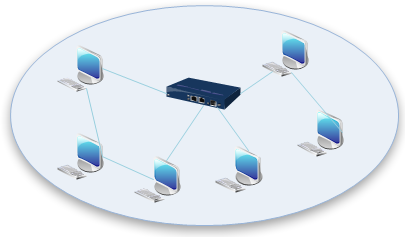
A mesh network in which every device connects to every other is called a full mesh. As shown in the illustration below, partial mesh networks also exist in some devices which are connected only indirectly to others.
See the illustration of Mesh Network Topology.
You can find more symbols for WAN diagrams here.