ROOM Diagram

Real-Time Object-Oriented Modeling (ROOM)
Model real time systems based on timeliness, dynamic internal structure, reactiveness, concurrency and distribution, using the ROOM notation.
ROOM is an object-oriented methodology for real-time systems developed originally at Bell-Northern Research. ROOM is based upon a principle of using the same model for all phases of the development process. ROOM models are composed of actors which communicate with each other by sending messages along protocols. Actors may be hierarchically decomposed, and may have behaviors described by ROOM charts, a variant of Harel's state charts. Descriptions of actors, protocols, and behaviors can all be reused through inheritance.
Edraw contains special shapes and settings for creating ROOM diagrams.
Free Download ROOM Diagram Software and View All Examples
ROOM Diagram Software Features
|
|
|
|
|
|
|
|
|
|
|
|
|
|
|
|
System Requirements
Works on Windows 7, 8, 10, XP, Vista and Citrix
Works on 32 and 64 bit Windows
Works on Mac OS X 10.2 or later
In Edraw Professional, the ROOM Diagrams templates and shapes are in the Software folder.
ROOM Diagram Symbols
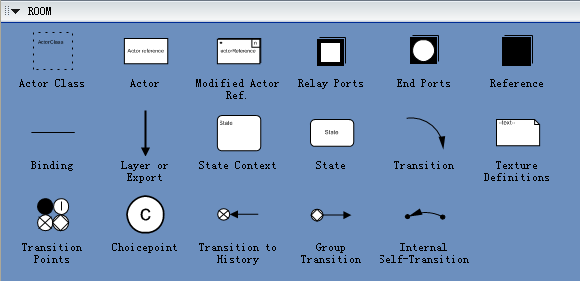
Some symbols can be changed into other shapes. When you drag them into the canvas, a dialog popup. Then you can choose the types.
For example:
Modified Actor Ref. An actor is an active architectural component of a software system. Actors interact with their environment via ports. A dynamic actor is created and destroyed by the containing actor.
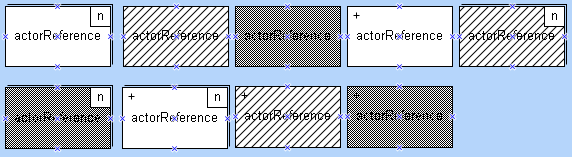
Ports provide an interface between actors using protocols that define how information should be accessed and changed.
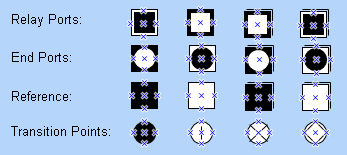
ROOM Port Type
- Relay port - Shares the interface between a contained class and the container class.
- Conjugated port - Handles both the outgoing and incoming messages of its protocol. Conjugated ports are usually white colored.
- External end port - Communicates with the actor's state machine or behavior.
- Internal end port - Connects a component actor to the container actor's behavior. It is illustrated by using the same notation as an external end port, but the port is placed inside the container border rather than on it.
Transition Points
- Initial transition point - Indicates the first transition within the state.
- Choice point - Indicates a choice between transition path segments. One path will be the default.
- Non-extending transition point - Marks the end of a transition that does not extend outside of the state context.
- Non-extending transition point - Illustrates an incoming transition.
What is a ROOM Diagram
Developed by ObjecTime (which was later acquired by
Rational Software), ROOM stands for real-time object-oriented modeling.
The actor or the software machine is the central component of the ROOM method.
ROOM diagrams illustrate both the structural and behavior aspects of the actor.
You can use ROOM diagrams in conjunction with the Unified Modeling Language (UML).
ROOMcharts
ROOMcharts are modified Harel Statecharts that illustrate the behavior of actors using states. ROOMcharts are also similar to uml's statechart diagrams.

